The product · one contract's life, stage by stage
A deal isn't done when it's signed.
FlowRights takes music contracts from first draft to flowing royalties. Here is what that means at every stage: draft, negotiate, sign, split, flow.
01 · Draft
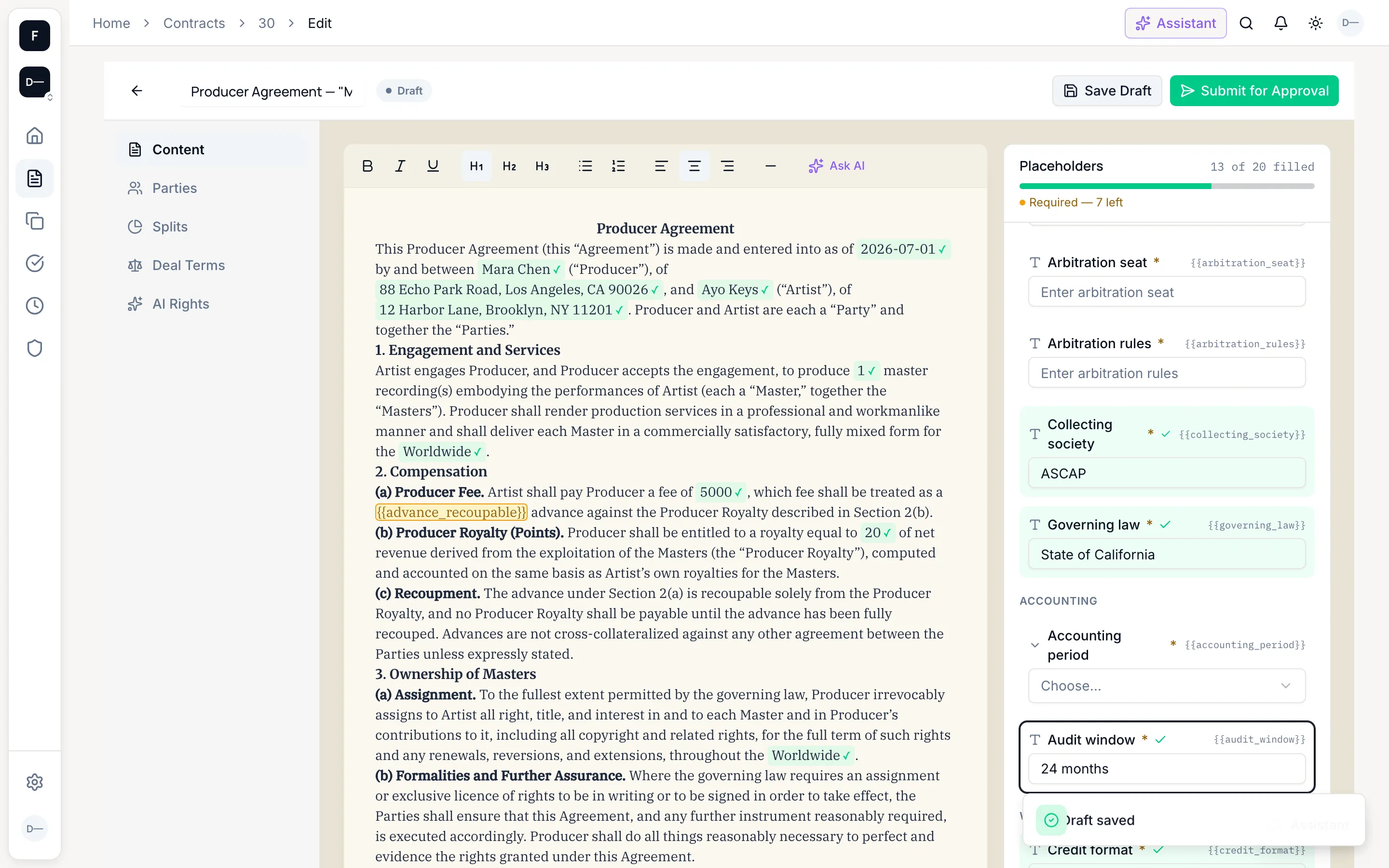
Start from templates built for music, not from a blank page.
Producer splits, sync licenses, 360 deals: the paperwork of music is specific, and the starting point should be too.
- Eleven contract types. Producer, publishing, master recording, sync license, distribution, work-for-hire, co-writing, 360, management, licensing, and "other" for everything else.
- Jurisdiction-aware templates. Template content scoped per jurisdiction (Nigeria, US, UK, generic), each behind a counsel review gate: draft → in review → changes requested → approved.
- Placeholders that know what they're for. Names, percentages, territory: filled from a draft panel of stateful placeholder chips instead of retyped into prose.
01 · Import
Or start from the document you already have.
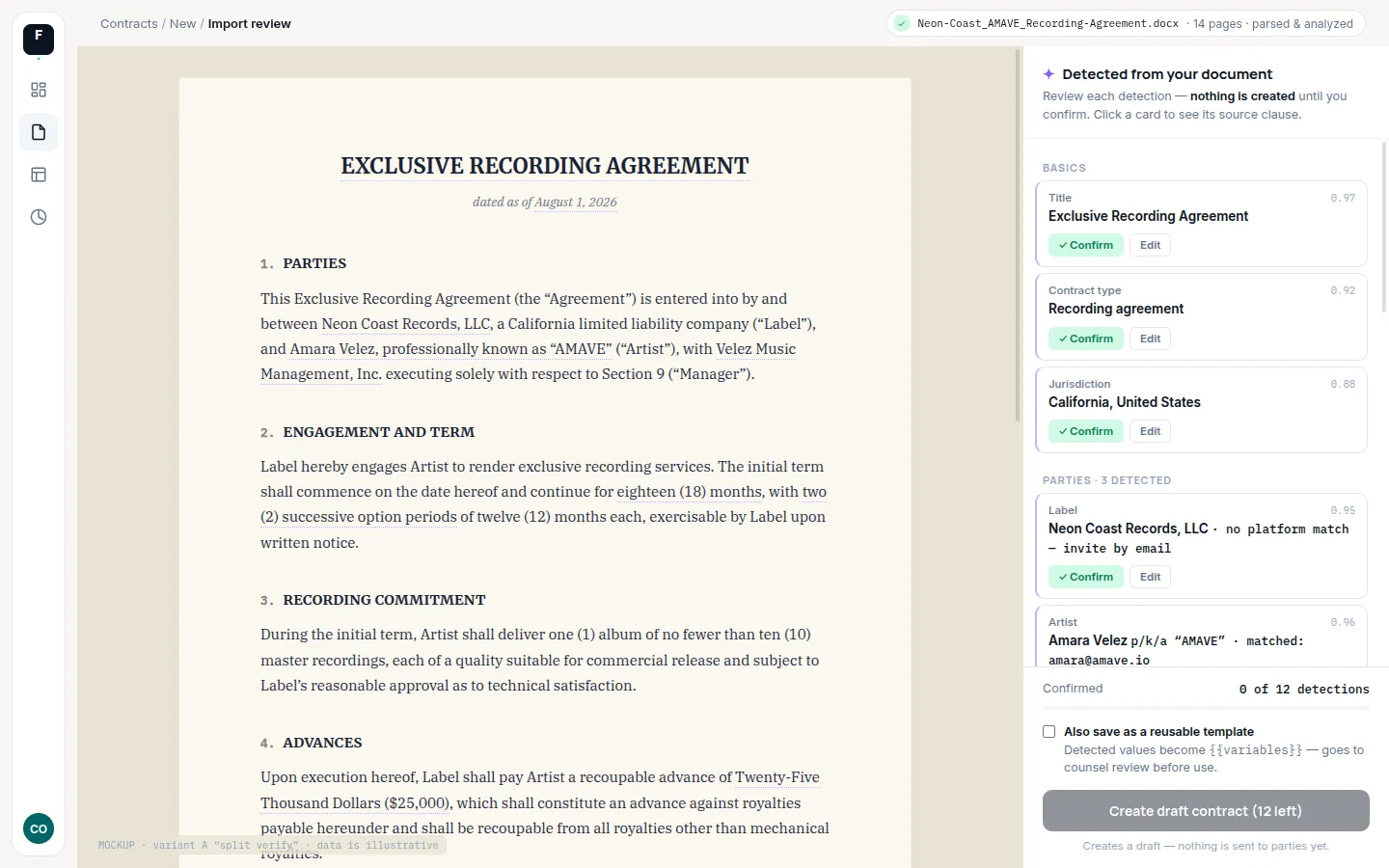
Real deals arrive as a DOCX from a lawyer or a PDF of a prior agreement. Upload that document instead of retyping it.
- AI reads the structure. Parties, revenue splits with their percentages, deal terms (advance, royalty rate, territory, term, dates), contract type, and jurisdiction, each detection with a confidence score.
- Nothing is created until you review. The document and its detections sit side by side; click a detection to see the clause it came from. Low-confidence fields ask for an explicit confirm, detected people are matched to workspace members or invited by email, and split warnings ("these sum to 95%") surface before a draft exists.
- Your wording is never touched. AI detects structure; it doesn't rewrite prose. The imported text is preserved verbatim and snapshotted as version 1, with the original file kept as provenance.
- Hardened on the way in. DOCX and text-layer PDF, verified server-side against the actual bytes and scoped to your workspace. Scanned PDFs aren't supported yet: you get a clear message, not a bad import.
02 · Negotiate
Every redline, every version, every party, in one place, not an inbox.
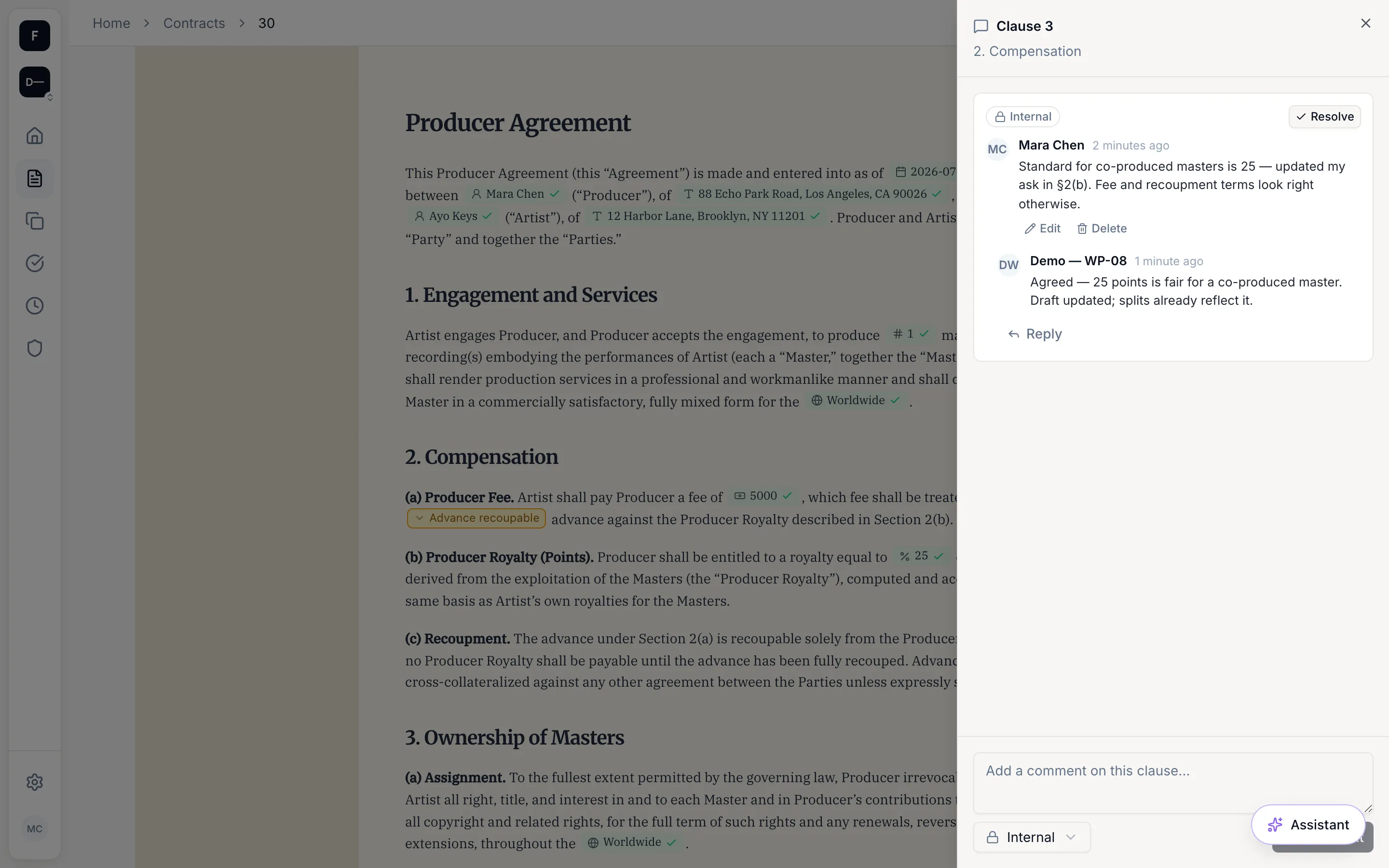
Multi-party negotiation without the forked Word attachments.
- Versioning with diffs. Tracked contract versions: see exactly what changed between v3 and v4, clause by clause.
- Per-clause threaded comments. Discussion pinned to the clause it's about, not lost in an email chain.
- Multi-party review. Artist, label, producer, counsel: everyone negotiates on the same document.
03 · Approve & sign
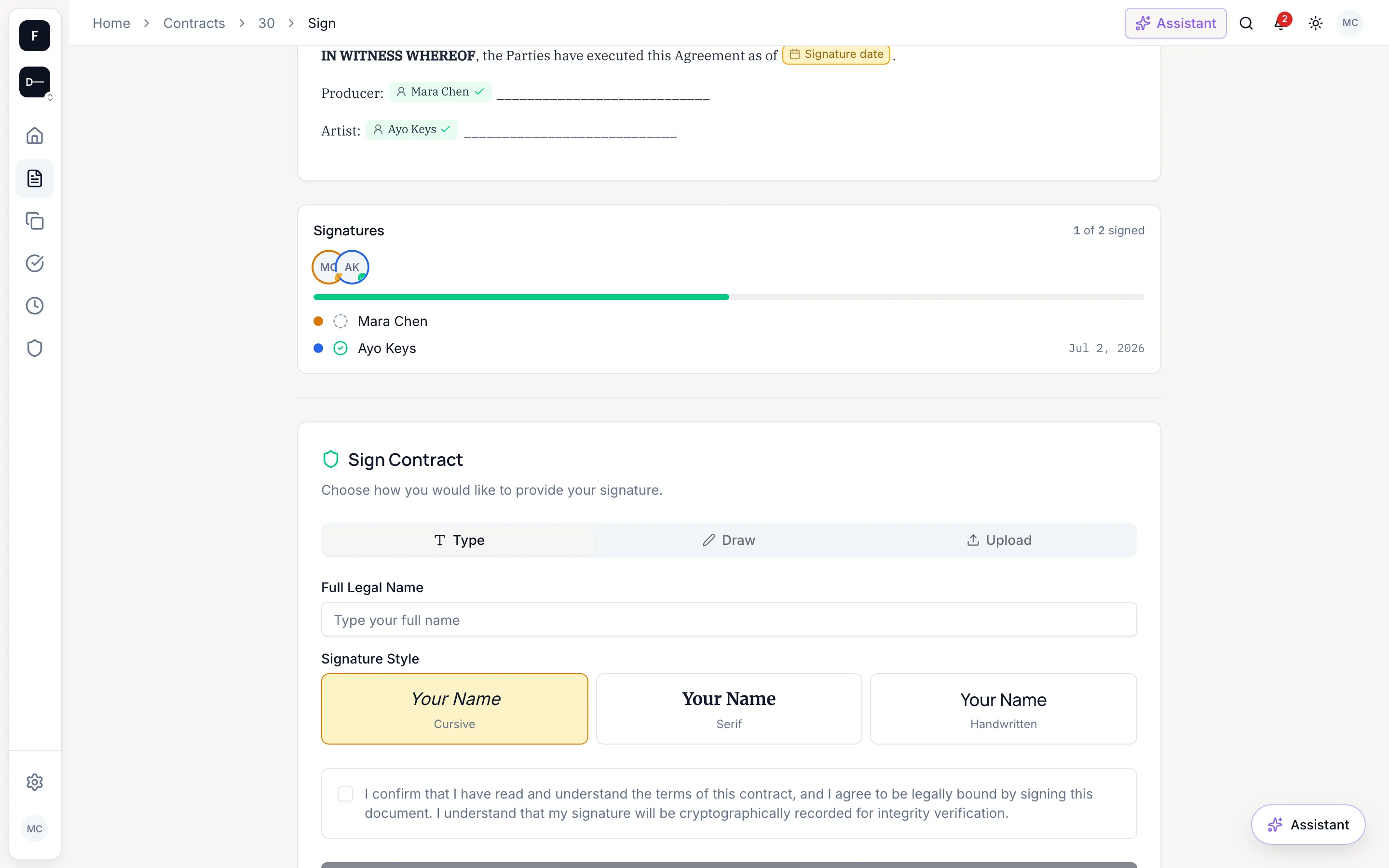
Approvals route themselves. Anyone can sign from a secure link.
The gap between "agreed" and "executed" is where deals stall. FlowRights closes it.
- Approval workflows. Manager, label legal, A&R: approval chains route the contract before signatures open.
- Signatures, three ways. Typed, drawn, or uploaded: captured with audit metadata.
- No account required for counterparties. Guest signing runs over a secure link, the only anonymous surface in the product, and rate-limited accordingly.
- Tamper-evident by default. Every executed contract is sealed with a SHA-256 fingerprint over its content, parties, splits, and terms; each signature carries its own hash. Any later change is detectable.
04 · Split
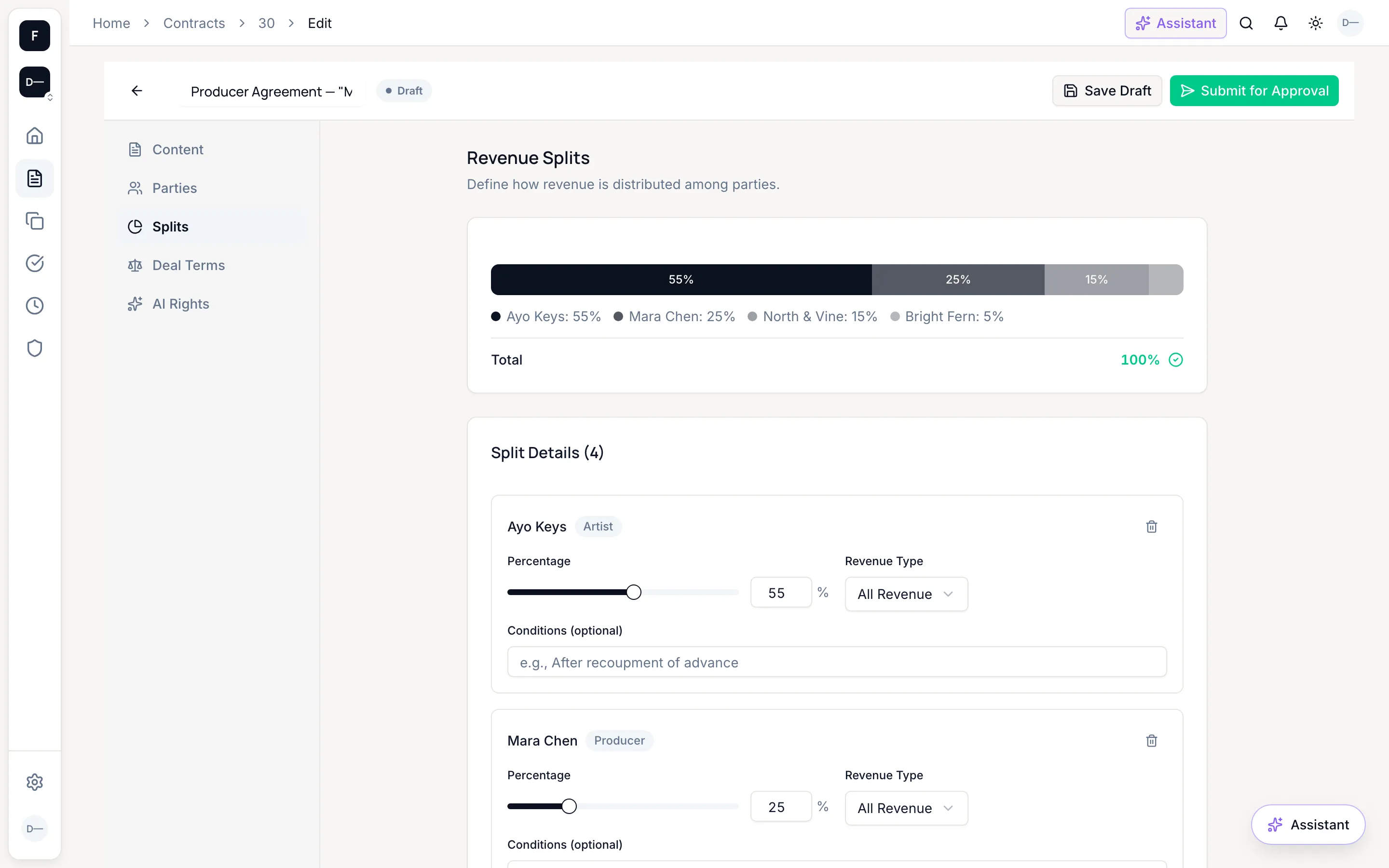
Splits are live data, not an appendix.
The percentages in Schedule A are the same records the royalty pipeline reads. No re-keying, no copy-paste drift.
- Percentage + revenue type per party. Each split line names a party, a share, and the revenue it applies to.
- Validated to 100%. The editor enforces that splits total one hundred percent. It is the brand's arithmetic, checked by machine.
- Signed once, synced exactly. The split terms in the executed contract are the split terms that sync onward.
05 · Flow
Splits push to Royalti.io automatically when the contract goes active.
Connect a Royalti.io workspace once; from then on, activation is the trigger.
- One-time connection. A workspace admin pastes a Royalti.io API key in Settings → Integrations; it's stored encrypted at rest (AES-256-GCM).
- Sync never blocks the deal. The push is best-effort by design: if Royalti.io is unreachable, the failure is recorded on the contract and the lifecycle proceeds.
- Visible and retryable. Sync status, an event log, and per-contract retry live in the app.
06 · The AI thread
Claude-powered analysis reads the fine print with you.
Alongside the document, never instead of it, and never legal advice.
- Plain-language summaries. What this deal is, who's involved, money terms, what you're giving up, key dates, watch-outs , written for people without legal training.
- Risk & fairness checks. Risk scoring, anomaly detection, consistency checks, and split-fairness analysis.
- AI Rights Registry. Per-work AI-training consent (opted in, opted out, or conditional) with ISRC/ISWC codes attached.
- Optional by design. Every AI feature is an overlay; the contract pipeline works without it.
And once it's active
The contract keeps working.
- Obligations tracking
- Deliverables and due dates tracked, with due and overdue notifications.
- Full lifecycle
- Seven states from draft to expired/terminated, with enforced transitions.
- Working tools
- Dashboard analytics, global search, PDF export, Google Drive integration, API keys.
- Accountability
- Role-based access across seven roles, audit logs, TOTP two-factor auth.
See the whole middle for yourself.
Open sign-up: no invite, no waitlist, no credit card required.
Start your first contract