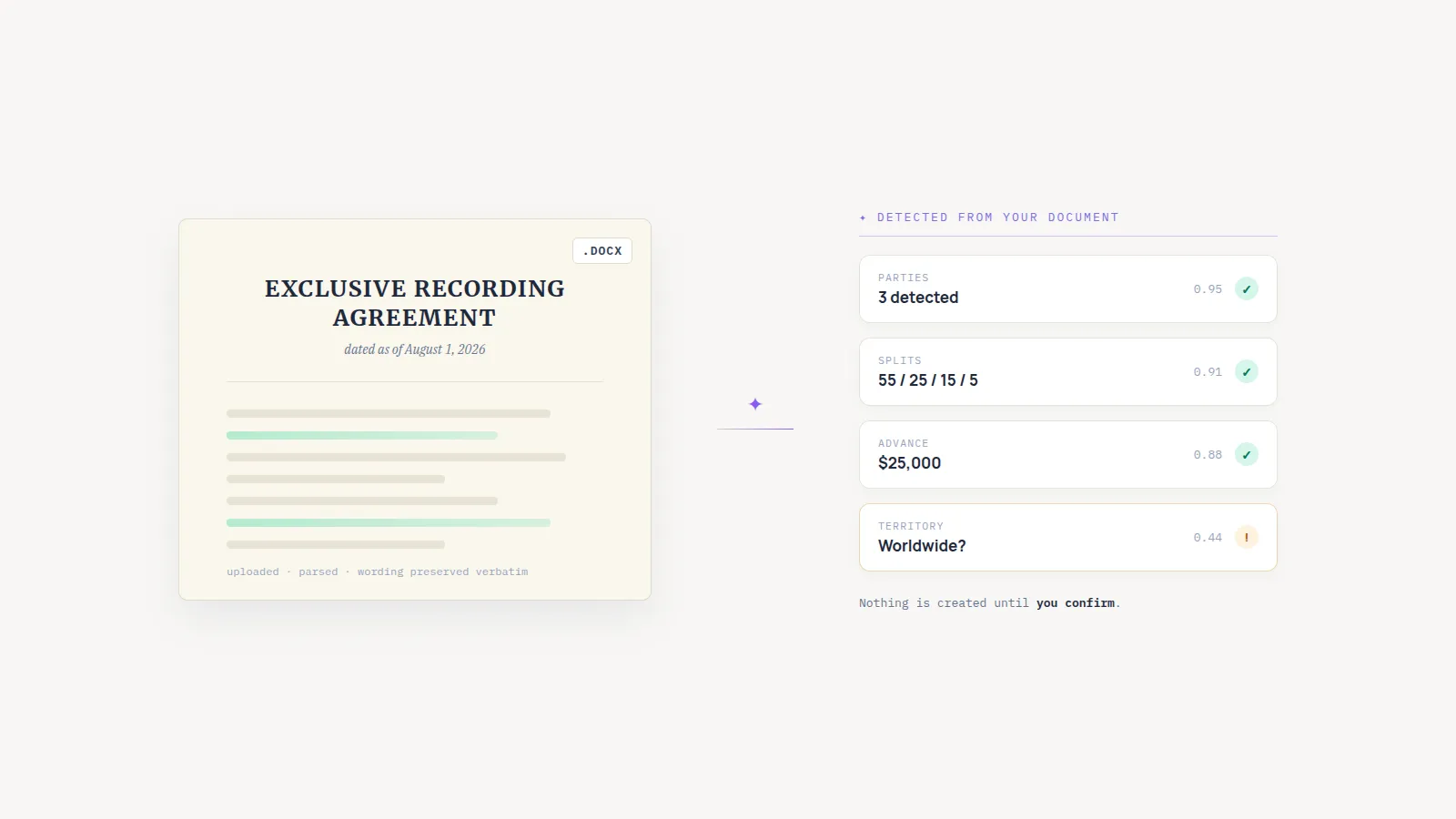
Most music deals do not begin in the tool that will manage them. They arrive as a DOCX from a lawyer, or a PDF of last year’s agreement. Retyping those documents into any system is slow, and every retyped percentage is a chance to get the deal wrong.
So FlowRights has a third way to start a contract, alongside starting from scratch and starting from a music template: start from the document you already have.
Upload it, and the structure surfaces
Bring a DOCX or a text-layer PDF into the new-contract flow. FlowRights parses the document, and AI reads out its structure:
- The parties, with their roles
- Revenue splits, with their percentages
- Deal terms: advance, royalty rate, territory, term, key dates
- Contract type and jurisdiction
Every detection carries a confidence score, so you can see at a glance which fields the AI is sure about and which deserve a closer look. The upload step says plainly that the document will be analyzed by AI; there is no fine-print surprise about what happens to your file.
Nothing is created until you say so
Detections are proposals, not decisions. Before any contract exists, everything lands on a review screen: the document on one side, the detections beside it. Click a detection and the clause it came from is highlighted, so you are checking the AI against the source, not against your memory.
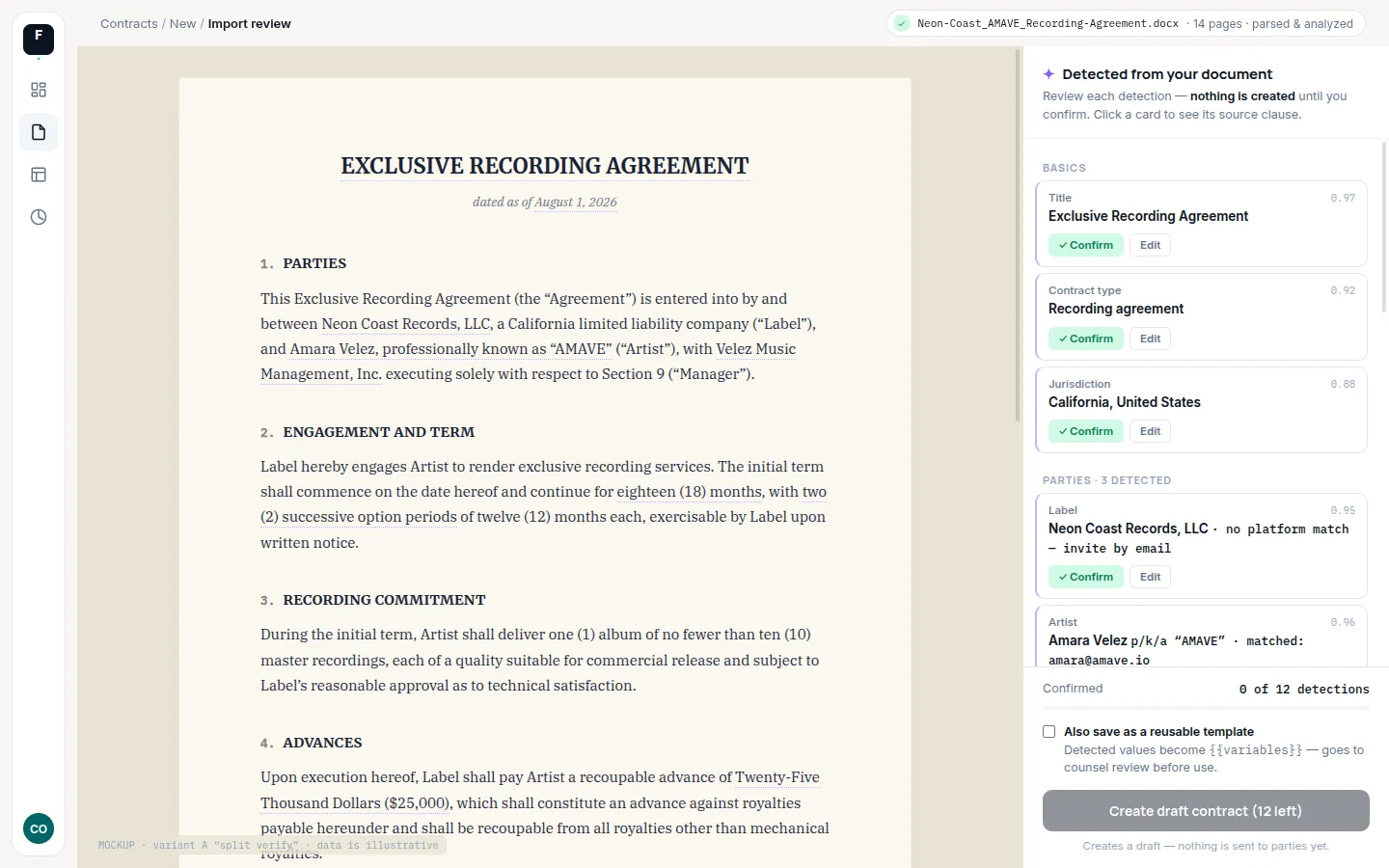
A few things happen on that screen that we think matter:
- Low-confidence fields require an explicit confirmation. There is no confirm-all shortcut past the fields most likely to be wrong.
- Detected people become real collaborators. Each party is matched against your workspace members, or invited by email if they are not on the platform yet.
- The arithmetic is checked on arrival. If the splits in the document total 95%, you hear about it before the contract exists, not after the first royalty statement.
Only when you confirm does a draft contract get created, with parties, splits, and deal terms already mapped. From there it behaves like any FlowRights contract: negotiation, approvals, signatures, live splits.
The words stay yours
This is the part we were most careful about. AI detects structure; it never writes or rewrites contract prose. The imported wording is preserved verbatim, snapshotted as version 1, and the original file stays attached as provenance. If a clause said something unusual, it still says exactly that, and you can always trace the contract back to the document it came from.
That is the same posture the rest of the platform takes: analysis sits alongside the document, never instead of it.
Honest limits
A few things this does not do yet. Scanned or image-only PDFs are not supported; the upload is rejected with a clear message and guidance rather than a bad import. OCR for scanned documents, importing straight from Google Drive, and saving an imported contract as a reusable template are all on the roadmap, not in the product.
And because an uploaded contract is exactly the kind of file worth being careful with, uploads are verified server-side against the actual bytes, checked for malicious archives, and scoped to your workspace.
Why this matters
FlowRights exists so that the percentages in a signed contract become live data that flows to royalty distribution without re-keying. Until now, that promise started at the template. Importing extends it to every deal that started on paper, which, for most working artists, labels, and managers, is most of them.
The deal you already negotiated deserves the same pipeline as the one you drafted here.