Somewhere between the last album cycle and this one, a new question attached itself to every catalog: can this recording be used to train AI models?
Most of the industry is answering that question with vibes. A statement in a bio. A position in an interview. A blanket “no” that nobody wrote down anywhere a licensee could find it. Positions are fine, but positions are not records. When the question actually matters, someone will ask what was agreed, for which work, and when.
Consent is a per-work fact
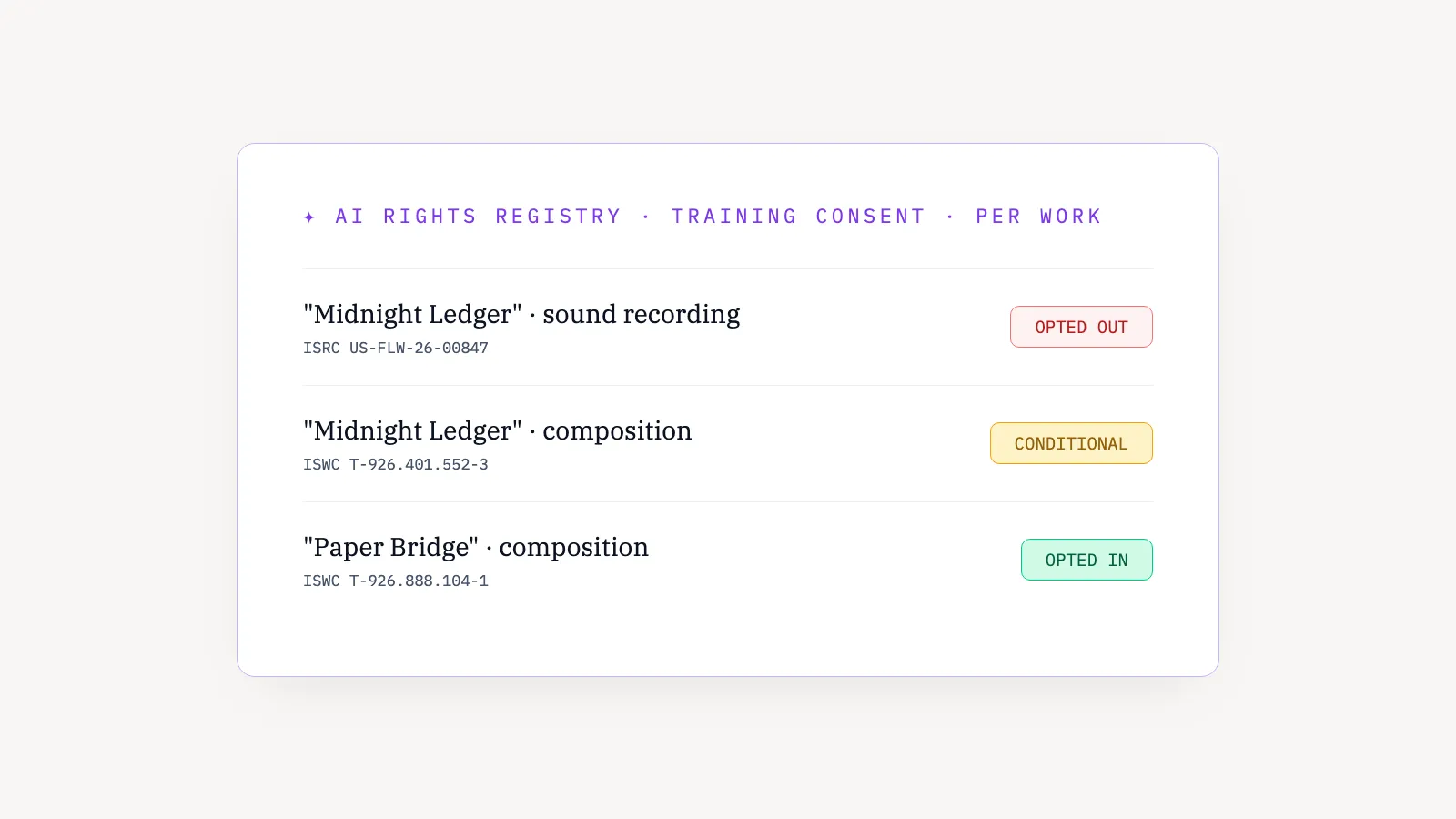
A catalog is not one thing. The sound recording and the composition of the same song can sit with different owners and carry different answers. A writer might happily license one album for training and fence off another. Blanket statements flatten all of that into a single word, which is exactly how disputes start.
The AI Rights Registry in FlowRights treats consent as a per-work fact. For each work, you record one of three states:
- Opted in. This work may be used for AI training.
- Opted out. It may not.
- Conditional. It may, under terms you control.
The registry covers six work types: sound recordings, compositions, lyrics, performances, music videos, and albums. Each entry carries its identifiers, ISRC for recordings and ISWC for compositions, plus the scopes it is licensed to. When someone asks what was agreed, the answer is a lookup, not an argument.
Why this lives next to your contracts
Consent does not float free. It comes from somewhere: a clause in a producer agreement, a term in a license, a decision by whoever controls the master. Keeping the registry inside the same platform that holds the contracts means the answer and its source stay adjacent.
It also means the record has the same discipline as everything else in FlowRights: role-based access, audit logs, and organization-level control over who can change what.
A note on the AI inside FlowRights
FlowRights itself uses AI, and it is worth being precise about what that means. Claude-powered analysis can summarize a contract in plain language, score risk, flag anomalies, and check split fairness. It works alongside the document, never instead of it, it is optional, and it is not legal advice.
The registry and the analysis point the same direction: AI in the music business should run on recorded consent and readable terms, not on assumptions.
Register the works, set the states, keep the codes attached. Future you will want the paper trail. Start here, or read more on the product tour.